Notes on RL for Robotics
Every RL algorithm answers one question first: whose data is the update allowed to use? On-policy methods learn only from experience the current policy just generated. Off-policy methods learn from anything: older versions of themselves, demos, a human teleoperator, another robot. Almost everything else (sample cost, stability, whether demos help, which robot problems fit) follows from that choice. This post builds both families from their simplest members and follows them into dexterous hands and vision-language-action (VLA) models. Spinning Up covers the details this post skips.
The setup in one paragraph
A policy \(\pi_\theta(a\mid s)\) acts, the world returns rewards, and we maximise expected return:
The subscript is the whole story. The objective is an average over trajectories from the current policy. On-policy methods estimate it directly by sampling from \(\pi_\theta\). Off-policy methods instead learn \(Q(s,a)\), the return of taking \(a\) in \(s\), which can be fit from any transition, and then pick actions that \(Q\) likes.
On-policy, from the bottom up
Policy gradient: make good samples more likely
Sample from the policy, then raise the log-probability of actions that did better than expected (\(\hat A_t > 0\)) and lower the rest. That is REINFORCE. The gradient is an expectation under \(\pi_\theta\), so once \(\theta\) moves the batch is from the wrong distribution and must be thrown away.
Everything on-policy since REINFORCE is one of two moves. Reduce variance by learning a baseline \(V(s)\) and using it to compute \(\hat A\) (actor-critic, GAE). Reuse each batch a little without the gradient going wrong. The second move runs into importance weights: to reuse data from an old policy \(\mu\), reweight each sample by \(\pi/\mu\). Drag the slider to see why that only works for small policy changes.
PPO: reuse the batch, but stay close
PPO takes a few epochs on each batch and simply stops caring about any action whose probability has already moved by more than \(\epsilon\). The weights never leave the safe zone, so the gradient stays roughly on-policy. (TRPO does the same with an explicit KL constraint.)
That is why PPO is robotics' default on-policy method: it only needs \(\log\pi\), rarely diverges, and scales with parallel simulators. When samples are free, wasting them is fine.
Off-policy, from the bottom up
Q-learning: the Bellman equation does not care who drove
This target needs one transition \((s,a,r,s')\) and nothing about which policy chose \(a\). So keep every transition in a replay buffer and fit to it forever. No importance weights, no discarding. The price: you are now regressing onto your own guesses (bootstrapping) on data your policy may never visit, and the \(\max\) picks out whichever estimate is most wrong in the optimistic direction. Off-policy learning is sample-efficient and fragile for the same reason.
Actor-critic for continuous actions: climb the critic
Robot actions are continuous, so you cannot enumerate \(\max_{a'}\). Instead, train an actor to output the action the critic rates highest, using states from the buffer \(\mathcal{D}\). DDPG, TD3 and SAC are all this idea; they differ in how they keep the critic honest (TD3: the pessimistic two-critic minimum above) and how they explore (SAC: add an entropy bonus). SAC is the usual choice on real robots.
Same budget, different reuse
Same 6×6 room, same budget of environment steps, reward only at the goal. REINFORCE uses each episode for one gradient step. Q-learning with replay reuses every transition UTD times per step.
So which one does robotics use?
Whichever one matches the cost of a sample. That gives a clean two-by-two.
Dexterity: on-policy at massive scale
Hands have 16–24 joints and contact-rich dynamics that are hard to teleoperate, so demos are scarce, but rewards are easy to write. GPU simulators make samples nearly free. That is the exact regime where on-policy wins, and the recipe since OpenAI's Dactyl has been PPO in randomized simulation:
With 104 simulated hands, each PPO update sees around 105 fresh transitions, so the bottleneck is wall-clock, not samples, and PPO's simple batched update wins. That is starting to shift: off-policy methods with huge batches (FastTD3, FastSAC, 2025) now match PPO's speed in sim, and only off-policy methods can also mix in real data. Real-world dexterous RL, where it happens, is off-policy and demo-seeded.
What dexterity RL can do, and where it breaks
Each clip links to the full video. Under it is the limit the authors themselves report.
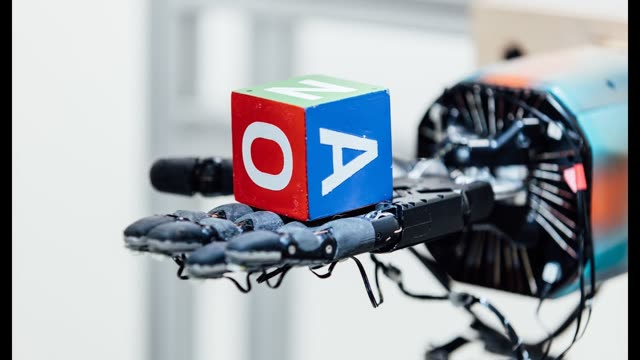 OpenAI
2018 Dactyl
13 in a row on the real hand; 50 in sim
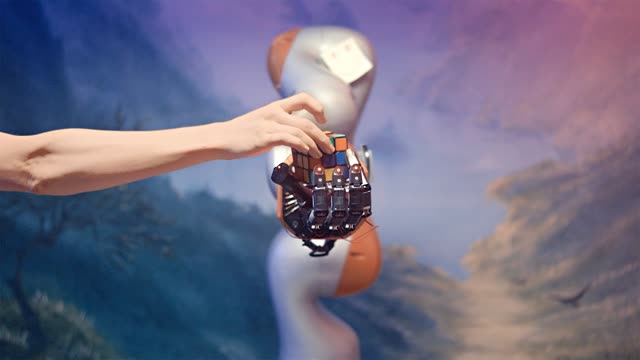 OpenAI
2019 Rubik's cube
20% success on the hardest scrambles
2022 Hora
one axis, no target orientation
2022 DeXtreme
median 14 in a row; finger cables break
2023 Visual Dexterity
drops unseen objects 56% of the time
2024 Pen spinning
direct sim-to-real failed (shown)
2025 Humanoid hands
short, slow tasks only
2024 HIL-SERL (real-world RL)
grippers, with a human watching
Off-policy on real hardware
On hardware a sample costs seconds of robot time, so you keep everything. The progress here is one idea refined: put every useful source of data in the buffer.
- QT-Opt (2018): Q-learning on 580k grasps from a robot fleet. Proved off-policy RL can absorb messy multi-robot logs, but took months.
- RLPD (2023): put demonstrations in the buffer and sample half of every minibatch from them. Demos become free off-policy data.
- HIL-SERL (2024): also put human corrections in the buffer. Reports near-perfect success on precise assembly tasks in 1–2.5 hours of real training.
RL on vision-language-action models
VLAs (OpenVLA, π0/π0.5, GR00T, …) are pretrained by imitation and get to "often works". RL is the attempt to reach "reliably works". The same trade-off applies, with three twists: models have billions of parameters, so every gradient step is expensive; diffusion and flow action heads have no cheap \(\log\pi\), which on-policy methods need; and rewards are a binary success at the end. The figure shows where each family of methods plugs in.
APPO on the whole VLA
actions = tokens, reward = success
VLA-RL, SimpleVLA-RL, RIPT-VLA
BPPO through denoising
each denoise step = an action
DPPO, ReinFlow, FPO
CSteer a frozen base
RL picks the noise, or adds a residual
DSRL, ResiP, Policy Decorator
DDistil RL experts
RL specialists → SFT the VLA
RLDG, iRe-VLA, ConRFT
ECondition on advantage
train on all data, ask for "good"
π*0.6 / Recap
FQ over chunks
TD on whole action chunks
Q-chunking, PA-RL
GRPO: the baseline is your siblings
Run \(G\) rollouts of the same task and judge each against the group average. No critic, which matters for a billion-parameter policy. The catch: a group that all succeeds or all fails gives zero gradient, so learning happens only on tasks at the edge of the model's ability.
The direction of travel
Where a simulator exists, on-policy RL on the whole model is the simplest thing that works. Where data comes from real robots, every method drifts to the stale end of the spectrum: learn a critic, keep everything, and use RL to reweight what the policy imitates. The open problem is an off-policy one: critics that are reliable for long, chunked, multi-task behaviour and cheap enough to train next to a VLA.
What nobody has solved yet
On-policy needs a simulator you can trust. Off-policy needs a critic you can trust. For dexterity and VLAs we have neither yet.
Physics we can't simulate
Fast, contact-rich motion is where simulators are wrong, and RL exploits it.
Learning on the hand itself
Hands break, drop things and need resets.
The last 1%
From "works in the video" to 99.9%, and proving it.
Seeing through your fingers
The hand hides the object it holds.
Rewards beyond poses
Tool use and assembly are hard to score.
Critics for generalists
Q-functions that hold up across many tasks.
Specialists into generalists
Fold many RL skills into one VLA.
Shared benchmarks
Every paper has its own hand and metric.
Where to go next
Foundations. OpenAI Spinning Up: key concepts, taxonomy of algorithms, policy optimization derivation, and the algorithm pages for VPG, PPO, DDPG, TD3 and SAC. Their key papers list covers 2013–2018 well.
- Mnih et al., Playing Atari with Deep RL (DQN), 2013
- Schulman et al., TRPO, 2015
- Schulman et al., GAE, 2015
- Lillicrap et al., DDPG, 2015
- Schulman et al., PPO, 2017
- Fujimoto et al., TD3, 2018
- Haarnoja et al., SAC, 2018
- Kalashnikov et al., QT-Opt, 2018
- OpenAI, Learning Dexterous In-Hand Manipulation, 2018
- OpenAI, Solving Rubik's Cube with a Robot Hand, 2019
- Kumar et al., CQL, 2020
- Nair et al., AWAC, 2020
- Kostrikov et al., IQL, 2021
- Qi et al., Hora: in-hand rotation via rapid motor adaptation, 2022
- Handa et al., DeXtreme, 2022
- Petrenko et al., DexPBT, 2023
- Chen et al., Visual Dexterity, 2023
- Ball et al., RLPD, 2023
- Luo et al., SERL, 2024
- Luo et al., HIL-SERL, 2024
- Shao et al., DeepSeekMath (GRPO), 2024
- Ren et al., DPPO, 2024
- Ankile et al., ResiP: from imitation to refinement, 2024
- Yuan et al., Policy Decorator, 2024
- Xu et al., RLDG, 2024
- Chen et al., ConRFT, 2025
- Lu et al., VLA-RL, 2025
- Li et al., SimpleVLA-RL, 2025
- Liu et al., What Can RL Bring to VLA Generalization? (RL4VLA), 2025
- Wagenmaker et al., DSRL, 2025
- Li, Zhou, Levine, Q-chunking, 2025
- Seo et al., FastTD3, 2025
- Physical Intelligence, π*0.6 and Recap, 2025
All interactive figures compute in your browser from fixed formulas or seeded simulations. The buffer-composition figure is schematic. Paper results are as reported by their authors.
Enjoy Reading This Article?
Here are some more articles you might like to read next: